Archives for March 2009

That Chili with the Mushrooms

March 31, 2009 · Filed Under dairy free, easy, entree, gluten free, recipe, soup, vegan, vegetarian ·36 Comments 

vegetarian-chili-0032My husband is most content as a carnivore, so when I made this vegetarian chili for us the first time, I simply said it was a new chili recipe that I wanted to try. Then I added that it called for a lot of mushrooms (which he absolutely loves). I used portabello mushrooms, which always add that nice “meaty” flavor. He ended up giving the chili high ratings, and so did I. Now when I make it, I just say I’m making “that chili with the mushrooms.” Oh, I did eventually tell him that it was a vegetarian recipe, but he didn’t care because it’s really good chili. It’s packed full of nutritious ingredients, extremely flavorful, and while it’s filling, it’s not “heavy” as meat-based chili recipes often are.

I found the original recipe when I was looking for a vegetarian recipe online that didn’t contain gluten to make for a friend. A lot of main dishes that are vegetarian contain gluten and I don’t cook with gluten (even for someone else—it’s just not safe). I was pleased when I found the recipe on allrecipes.com because it had many reviews, all of which were excellent. Just like those of us who are gluten free, vegetarians sometimes have to settle for salads or mediocre vegetable side dishes for their meals, but with this chili my friend didn’t have to “settle” at all. She loved this chili and I was really surprised at how much I enjoyed it as well. So much so, that it’s now on the regular menu “rotation” at our house. I’ve come to actually prefer this recipe to my meat-based chili.

I made it on a recent Sunday, with plans to feed both of us and then have plenty left for our support group on Tuesday.

vegetarian-chili-0141

april-meeting-005

The recipe below perfectly fills a 4-qt crockpot. However, when I was ready  to serve this chili to our support group (they’ve also become big fans!), I wanted to balance out the flavor from the fresh tomatoes (a little too many as it turned out) and re-fill my 6-qt Rival Smart-Pot. So, I added another can of kidney beans, another can of chickpeas, and another half jar of salsa to start. I wanted to add another can of black beans, but since I had already used my last can, I decided to added a can of black-eyed peas. So ”that chili with the mushrooms” take two is shown below.  The results were just as delicious as ever, so obviously this recipe is the best kind—adaptable to what you have on hand, naturally gluten free, and easy to make … so gluten free easily—GFE! By the way, I’m not normally one to eat chili year round, but this recipe is an exception. ;-)   

april-meeting-034-1  

img_5385My flat and firm cornbread was the perfect complement to this chili. Because we have some members who are gluten free and dairy free, I made two versions—one with milk and butter and another using olive oil and rice milk. (See olive oil to butter substitution guide here.) The latter version was a little crumbly, but still had the same great flavor. Next time I make the dairy-free version, I am going to decrease the amount of rice milk slightly and add a little xanthan gum. (When I get just the right mix, I’ll update the cornbread recipe to show the best adjustments for the non-dairy version.)

That chili with the mushrooms and flat and firm cornbread … quite a nice combination. What’s your perfect chili combination? Do you make vegetarian chili?

Shirley
Not just GF, but GFE!

That Chili with the Mushrooms (Vegetarian Chili)
(Click here for a print version of this recipe.)

Ingredients

· 1 tablespoon vegetable oil (I used olive oil)
· 1 cup chopped onions
· 3/4 cup chopped carrots (optional, I didn’t use)
· 3 cloves garlic, minced
· 1 cup chopped green bell pepper
· 1 cup chopped red bell pepper
· 3/4 cup chopped celery (optional, I didn’t use)
· 2 tablespoons chili powder
· 1 1/2 cups chopped fresh mushrooms (I used portabella)
· 1 (28 ounce) can diced tomatoes with liquid, chopped (I used a combination of fresh tomatoes and canned diced petite tomatoes)
· 1 jar salsa (or 1 tbsp tomato paste and do not drain/rinse kidney beans and add additional chili powder to taste)
· 2 (19 ounce) can kidney beans drained and rinsed
· 1 can chick peas, drained and rinsed
· 1 can black beans, drained and rinsed
· 1 (15 ounce) can whole kernel corn, drained and rinsed, or equivalent amount of frozen corn (I used Bird’s Eye baby gold and white corn, which is excellent)
· 1 1/2 teaspoons ground cumin
· 1 1/2 teaspoons dried oregano
· 1 1/2 teaspoons dried basil

Directions
1. Heat oil in a large saucepan over medium heat. Saute onions, carrots (optional), and garlic until tender. Stir in green pepper, red pepper, celery (optional), and chili powder. Cook until vegetables are tender, about 6 minutes.

2. Stir in mushrooms, and cook 4 minutes. Transfer ingredients to your crockpot. Stir in tomatoes, kidney beans, chick peas, black beans, and corn. Season with cumin, oregano, and basil. Cook for 7 to 8 hours on low.

Shirley’s Notes: Although I like carrots and celery, the first time I made this recipe I didn’t have any on hand, so I think you can consider those as optional. Next time, I am going to be sure to have some carrots and celery on hand and give them a try though. Again, this recipe is flexible according to what one has on hand or if you are doubling it. I generally prepare everything in the crockpot the night before, so I don’t have to rush in the morning and so it is not overcooked by the time I get home from work. (My 4-qt crockpot does not have an automatic shutoff.) The cold ingredients guarantee a slightly slower start. I generally follow this approach even with my crockpot that switches from cooking to warming just so I’ll have the ingredients ready to go in the morning. I’ve also cooked this and other crockpot recipes overnight before.

Adapted from a recipe on allrecipes.com

Passion for Peanut Butter Cookies

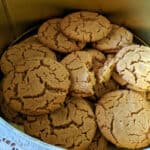
peanut-butter-cookies-0092One of my standby cookie recipes back in the day (translation: when I was eating gluten) was peanut butter. I always made them for my dear friend, Cindi, for special occasions like her birthday or when she just needed a “pick-me-up. ” She would just flip over my peanut butter cookies, so I obliged as often as I could. After going gluten free, I was anxious to find a worthy replacement. I kept seeing a flourless peanut butter cookie recipe on the celiac listserv and on other blogs. It only required peanut butter, an egg, and granulated sugar. However, I had actually tried this recipe years earlier because I’d been intrigued by the few ingredients. While the cookies turned out okay, they didn’t wow me. Quite some time later, I saw another recipe for peanut butter cookies on the celiac listserv. This one looked more promising. The ingredients were: peanut butter, brown sugar, an egg, baking soda, and vanilla. Plus, you could use smooth or chunky peanut butter and you could add chocolate chips if you liked. Hmmm, make that very promising.

I eagerly made the recipe and the peanut cookies were the best—even better than my old, standby recipe! The first dozen times I made them, I used chunky peanut butter and mini chocolate chips. Yum. Delightfully chewy with just the right amount of chocolate. I’ve even made them with regular-sized chocolate chips and chocolate chunks. As expected, the chocolate merits almost equal billing with the peanut butter in those versions. Using chocolate chunks actually elevates these cookies to a whole new level. The big semi-sweet chocolate chunks show through the surface, making the cookies very appealing, but better yet, the chunks stays soft and gooey after baking. How often does that happen? Not often in my experience, but it’s certainly wonderful when it does. Still, most of the time now I tend to go for the classic version when I make these cookies—using smooth peanut butter (no chocolate chips needed). Simply delicious.

Because there’s no flour of any kind in all versions of these cookies, the peanut butter flavor really stands out. For a purer peanut butter pleasure, if you will. If you are a peanut butter lover, that’s a great thing! I always make these cookies as one of my sweet treats for parties (like our Valentine’s Day party, hence, the picture above).  And, this recipe is also the first one I share with those who are newly gluten-free. Everyone is always amazed that they don’t contain flour, but yet have just the right cookie consistency and flavor. What’s really neat is that folks can usually go right home and make some for themselves, because the ingredients are ones most of us are likely to have on hand (that is, in homes where family members do not have peanut allergies).

Another nice thing about this recipe is that these cookies can be made quickly. I sometimes make them before going to work when I’ve promised to bring in a treat. I’ve also made batches right after work to add to a care package for a friend. Just a little prep time and about two cookie sheets worth of baking and you are done! It’s a great recipe for children to make, as well. It’s easy and fun for them to roll the dough into balls, remove the cookies from the cookie sheet, and, of course, taste the results of their efforts. Try these … if you like peanut butter cookies, you won’t be disappointed! I think my friend, Cindi, will definitely approve when I make them for her when she returns to Virginia soon. Or maybe she’ll go ahead and give them a test run with the able help of her daughter, Olivia. :-)

Flourless Peanut Butter Cookies
(Click here for a print version of this recipe.)

1 cup peanut butter, smooth or chunky/crunchy
1 cup brown sugar
1 egg
1 tsp baking soda
½ tsp vanilla
1 cup semi-sweet chocolate chips (optional—mini, regular size, or chocolate chunks)

Preheat oven to 350 degrees. Mix all ingredients (except chocolate chips) together well. Last, add chocolate chips (if desired) and mix well. Grease or moisten hands slightly and form dough into 1-inch balls. Place balls on ungreased cookie sheet. (DO NOT press down as in some traditional recipes.) Bake 8 – 10 minutes or until golden brown and cookies look “set,” but not done. Do not overcook. Then allow cookies to sit on cookie sheet for 5 minutes. (This step is very important, because cookies finish cooking during this time and totally set up.) Remove cookies for cooling.  Makes about 24 – 30 cookies. If you want to turn these cookies into a really decadent treat, get out your jar of Nutella and spread some on the underside of one cookie and then press another cookie on top (top side out). See the resulting Peanut Butter Chocolate Hazelnut Sandwich Cookie here.

Shirley’s Notes: Do not use low-fat peanut butter; the cookies will not turn out correctly. I use Jif (all are GF), but it’s my understanding that Peter Pan (all), Planters (Creamy and Crunchy), Reeses, and Skippy (Creamy, Crunchy, Super Crunchy, Roasted Honey Nut) are also GF. Ensure your vanilla and chocolate chips are GF. I make my own vanilla, but most are gluten free (e.g., McCormick’s). 

From the celiac listserv (originator unknown)

blog-pb-cookies

blog-pb-cookies-table

This post is linked to What can I eat that’s gluten free?

Shirley
Not just gf, but gfe!

20+ Reasons to Get Tested For Gluten Issues

March 14, 2009 · Filed Under diagnosis, symptoms ·34 Comments 
When I speak on celiac/gluten intolerance or talk to individuals who might have gluten issues, I provde an information folder I’ve developed over the years. In it, is the 20+ REASONS TO GET TESTED FOR GLUTEN ISSUES listing shown below.  (I compiled this listing from various sources. It will be a permanent feature on my website. Just click on the 20+ Reasons You Should Get Tested for Gluten Issues under the gfe tip sheets section on the sidebar to get the listing as a PDF file.) One of the frustrations with trying to make or get a diagnosis for gluten issues (from gluten sensitivity to celiac) is the fact that no two individuals will experience the same exact symptoms and no two resources (medical websites, reference books, etc.) will list the same symptoms.  I had a number of symptoms on the listing over the years, but not all at the same time … which frankly just adds to one’s own confusion, as well as the doctor’s. Admittedly, in some ways, it’s like chasing a moving target. To further complicate matters, some individuals may only experience one symptom and about 40% of those diagnosed with celiac state they had no symptoms. (I believe that last figure could be highly inflated, due to individuals not recognizing symptoms as issues or symptoms being attributed to other medical conditions.) Hence, one rarely goes down a straight and narrow path with testing and diagnosis.  
 
The National Foundation for Celiac Awareness (NFCA) states that the average time a person waits to be diagnosed is 10 years. (No data is available on the time needed for diagnosis of non-celiac gluten sensitivity and gluten intolerance.) The multicenter study published in 2003 (read more here) showed that about 1 in 133 have celiac disease in the United States. That figure equates to approximately 3 million people. In comparison, 2.7 million have epilepsy. About 2.1 million have rheumatoid arthritis.  Lupus affects 1.5 million people. Type 1 diabetes affects 3 million people (6% of those individuals also have celiac).  Multiple sclerosis affects 400,000 Americans. The number of people with celiac in the U.S. would fill 4,400 Boeing 747 airplanes! Are you surprised that many people have celiac when you see the statistics compared to the incidence of other disease? Most are. Somehow the 1 in 133 statistic doesn’t have the same impact until it’s shown in comparison to other well-known conditions. (Read more facts and figures about celiac in this large PDF file from The University of Chicago Celiac Center.) When the study establishing the incidence rate of celiac was published, it was estimated that 97% of individuals with celiac remained undiagnosed. Today, the NFCA estimates that 95% remain undiagnosed.   
 
While progress is being made, many can’t get a celiac diagnosis. Some choose to go on a gluten-free diet on their own after doing research and talking to others who have experienced resolution of symptoms by eating gluten free. Some see the “writing on the wall” because they have family members diagnosed with celiac who shared their same symptoms before going gluten free. Some have the good fortune to connect with a good functional medicine physician, who believes that celiac is a subset of a larger realm of gluten sensitivity and gluten intolerance. These individuals are often directed to take the gluten sensitivity test to determine if gluten is an issue for them. (I happen to be in this latter category.)  Others, while suffering, may still be eating gluten because their health care professionals have told them gluten is not a problem for them and they should continue eating it.
 
Take a look at these symptoms/conditions associated with gluten. If you have already been diagnosed and/or gone gluten free, you may well see issues you used to have or if newly GF, ones that are improving every day. Otherwise, are these symptoms you have experienced?  Gluten could be the cause. Please don’t dismiss these symptoms. For most of my life, I thought my symptoms were just unique to me; i.e., that’s the way my body was. Doctors reinforced this thinking by saying things like “Everybody’s different. Your (insert symptom here) may be normal for you.” Sometimes people say to me that they have osteoporosis, but it “runs in my family.” I maintain that it’s not osteoporosis that runs in their family, but what’s causing the osteoporosis that runs in their family. Maybe the cause is actually gluten-related. Celiac is a disease of malabsorption, which means that the folks who suffer from it are not absorbing the vitamins, minerals, and fat that their body should be. For many of the symptoms/conditions listed below, malabsorption caused by gluten issues is the cause. Check out this list and know that as extensive as it is, it’s not all inclusive. One of the most rewarding things about being a support group leader and speaker on celiac and gluten issues is seeing the transformation in people after they go gluten free. It’s quite a pleasant revelation to note all the things one doesn’t have issues with any more after being on a gluten-free diet! 
Shirley
Not just GF, but GFE!
 
20+ REASONS TO GET TESTED FOR GLUTEN ISSUES

  1. A family member has been diagnosed with celiac/gluten intolerance or a disease that is associated with celiac/gluten intolerance
  2. Gastrointestinal issues, such as diarrhea, constipation, or alternating; IBS; abdominal pain; nausea; vomiting; stools that are smelly, large volume, and/or float; acid reflux (GERD); bloating; gas; belching/burping; etc.
  3. Skin issues: rashes (including blisters as in dermatitis herpetiformis), eczema, psoriasis, vitiligo, “allergies” to products that touch skin
  4. Diagnosis of other disease/conditions that can be related to gluten or “run in your family,” such as any form of arthritis, multiple sclerosis, fibromyalgia, diabetes, chronic fatigue syndrome, thyroid issues, or adrenal issues
  5. Anemia
  6. For women, gynecological/obstetric issues, such as premenstrual disorders, difficult menstrual periods, endometriosis, infertility, difficult pregnancies, miscarriages, stillbirths, hormone issues, and early menopause
  7. Neurological and psychological issues, such as depression, seizures/epilepsy, ADD/ADHD, learning disabilities, autism, tingling/numbness (neuropathy), bipolar disorder, irritability/”moodiness,” schizophrenia, “brain fog,” trance-like episodes, anxiety/panic attacks, OCD, dementia/Alzheimer’s, ataxia, restless leg syndrome
  8. Osteoporosis or osteopenia
  9. Insomnia and/or other sleep issues
  10. Frequent headaches (e.g., tension/sinus/migraine)
  11. Other organ issues: such as appendicitis; gall bladder, kidney, liver problems
  12. Other food allergies/issues, such as lactose intolerance
  13. Weight issues (underweight and can’t gain weight easily or average weight/overweight and can’t lose weight easily)
  14. Frequent infections/illnesses: sinus, strep throat/tonsillitis, bronchitis, ear infections, “virus”/”bug”/”flu”
  15. Down syndrome
  16. Cancer—particularly stomach, pancreatic, lymphoma
  17. Frequent or constant fatigue
  18. Canker sores/mouth ulcers
  19. In children: failure to thrive, developmental delays (e.g., speech, puberty), short stature, distended belly, leg aches/pain (e.g., “growing pains”), irritability
  20. Asthma
  21. Hair issues (e.g., hair falling out/thinning, bald spots/alopecia)
  22. Blood pressure issues (low or high) 
  23. Dental issues (e.g., discolored teeth/enamel defects)
  24. Sjogren’s syndrome 

  25.  Note: Listing is also available in PDF here.


Related Posts with Thumbnails

Next Page »